
100% Whole Wheat Bread with Freshly Milled Wheat

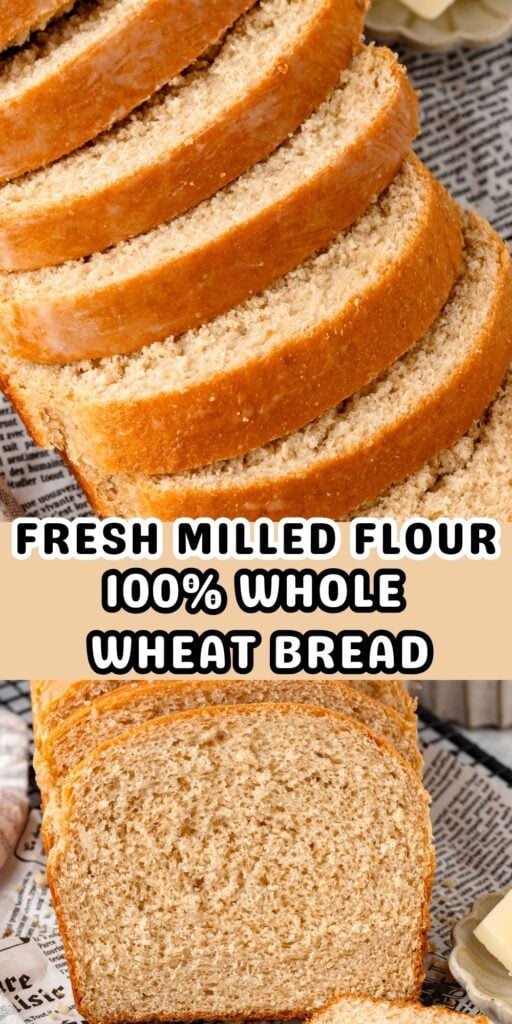
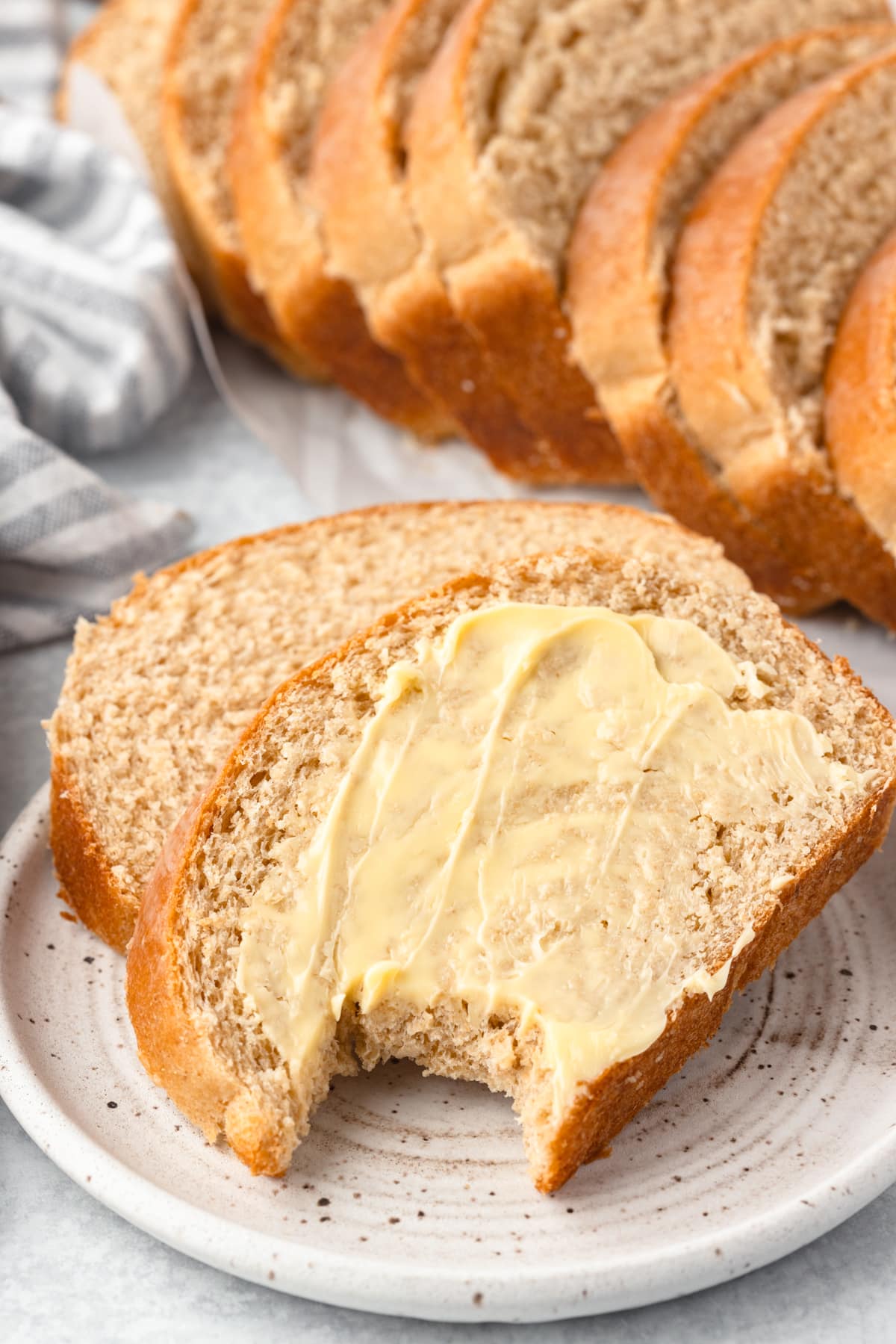
This 100% Whole Wheat Bread made with fresh milled flour is one of my favorite everyday bread recipes. Made with freshly milled hard white wheat, it has a mild whole wheat flavor and makes a beautiful loaf for sandwiches, toast, or eating warm with butter.
Looking for more Fresh Milled Flour Recipes? Check out my Dinner Rolls, Khorasan (Kamut) Sandwich Bread, or Cheddar Garlic Biscuits.
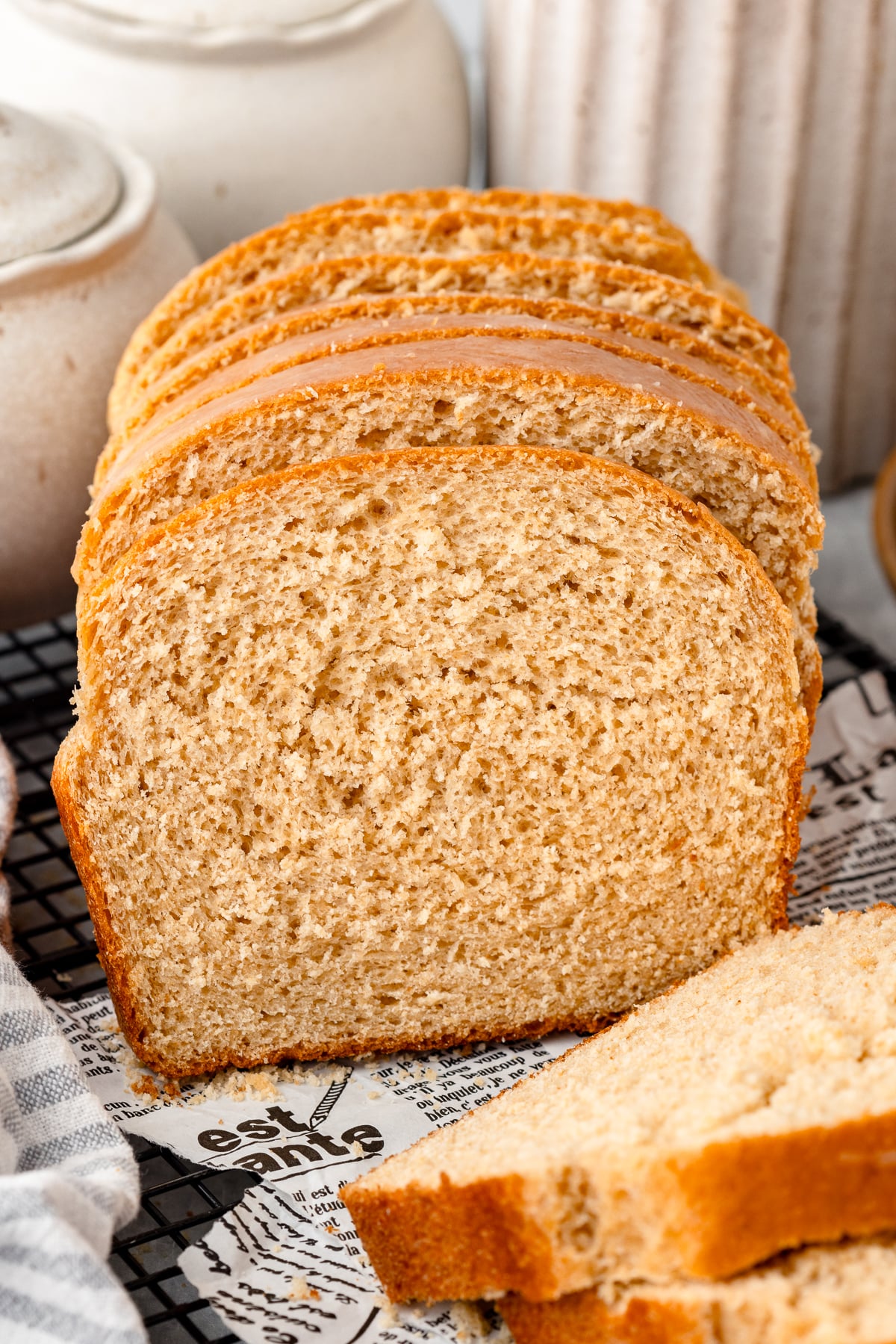
Recipe Update: I recently updated this recipe to make 2 loaves instead of 1 and added gram measurements for easier weighing. I also added an egg for each loaf, which helps the bread hold together better and give it a softer, less crubmly texture. The bread pictured here was made without eggs, as you can see it still has great texture. So with or without eggs, it works out great!
Why I Love Baking Bread with Freshly Milled Flour
Once I started milling wheat berries at home, I didn’t want to go back to store-bought whole wheat flour! Freshly milled wheat has a slightly sweet, nutty flavor that works so well in homemade bread.
Milling your own flour also means you’re using the entire wheat berry, including the bran, germ, and endosperm. I usually mill my flour right before baking, but I also mill extra and freeze it so I always have some ready to use.
How I Started Baking with Freshly Milled Flour
Several years ago, my husband mentioned something he thought I’d find interesting. A woman on a religious program was talking about milling wheat berries. That woman was Sue Becker from Bread Beckers, and I was instantly fascinated. Her words sparked something in me, and I started researching everything I could about fresh milled flour!
Before long, I ordered a grain mill, some wheat berries, and her cookbook. I began baking fresh bread for my family, hoping it might help two of my sons who struggled with chronic constipation. To my surprise, it worked! Their stomach issues went away completely.
Even though I had more than 20 years of experience baking bread, freshly milled flour was a whole new challenge! My old bread methods didn’t work the same way. I had crumbly loaves, flat loaves, and plenty that didn’t turn out the way I wanted. I kept experimenting though, and eventually learned what fresh milled flour needs to make a great loaf.
Before you dive in, if your fresh milled flour bread has ever come out dense, gummy, or just not quite right, my Complete Guide to Freshly Milled Flour is exactly what you need!
It walks you through everything I wish someone had told me when I started, so you can stop guessing and actually get it right. Grab it right here. Complete Guide to Freshly Milled Flour!
Why I Add Apple Cider Vinegar to Whole Wheat Bread
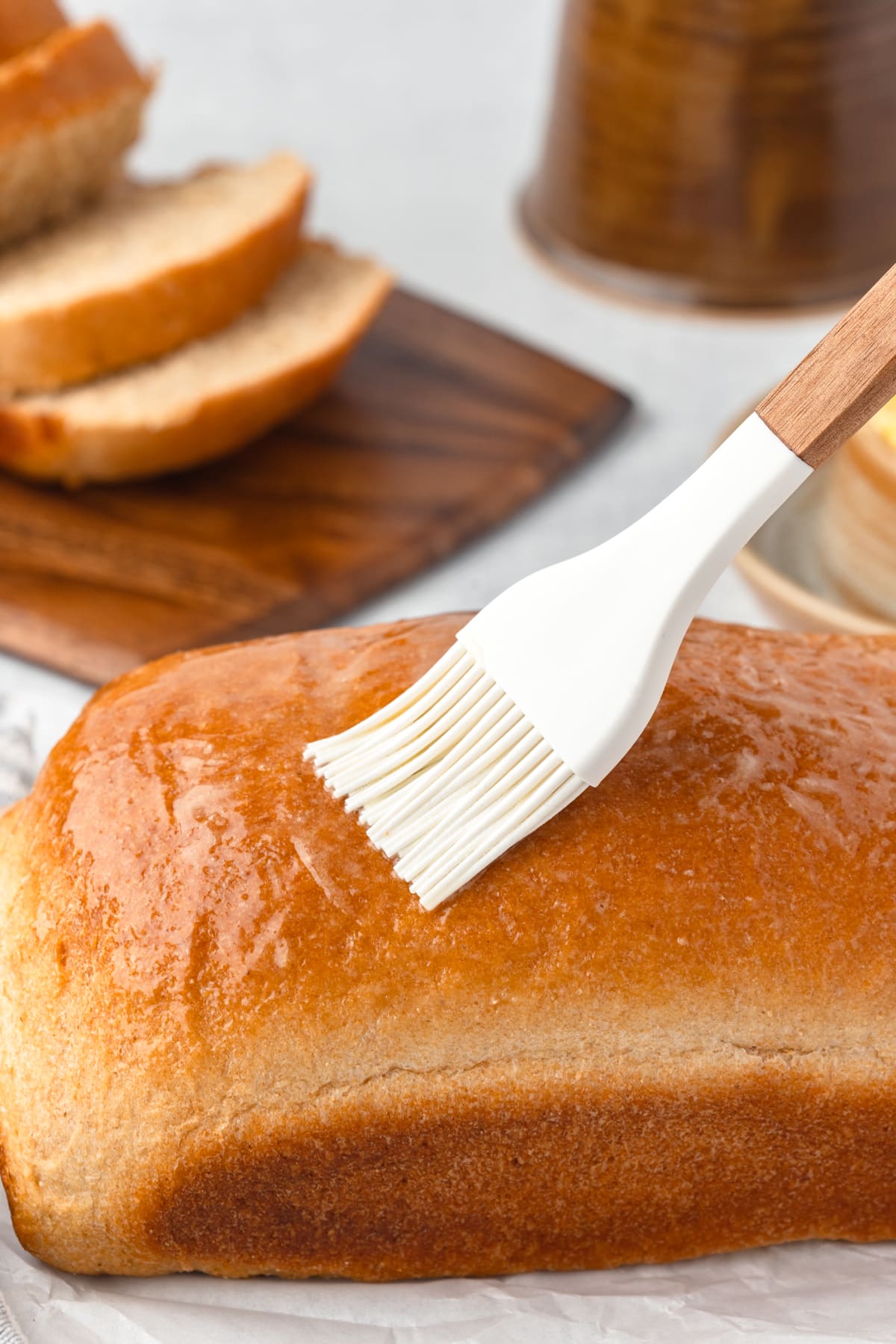
I started out using the recipes in Sue Becker’s cookbook and eventually began developing my own. I worked on this bread for about a year and a half before I tried adding apple cider vinegar, and that small change made a noticeable difference!
For me, the biggest difference was in the crumb. The bread held together better and wasn’t as crumbly. You only need 1 teaspoon, and you won’t taste the vinegar in the finished loaf, I promise!
What you’ll love about this Freshly Milled Whole Wheat Bread:
Ingredients
- Freshly Milled Hard White Flour
- Milk
- Honey
- Butter
- Active Dry Yeast
- Apple Cider Vinegar
- Salt
- Eggs

Ingredient Notes
Hard White Wheat: This is my favorite wheat berry for everyday bread. It has a milder flavor than hard red wheat while still having the protein needed for yeast bread.
Whole milk: I prefer whole milk because it adds richness and gives the bread a tender texture. Warm the milk before adding the yeast.
Honey : Adds a touch of sweetness without making the bread taste sweet. I especially love the flavor of honey with whole wheat.
SAVE THIS RECIPE FOR LATER!
Apple cider vinegar: This is my secret ingredient! Just a small amount helps my bread hold together better and be less crumbly. You won’t taste the vinegar!
Salt : Don’t leave it out! Salt is important for both flavor and controlling the yeast, so I don’t recommend reducing it.
Eggs, optional: I made this bread without an egg for years! In fact, all the pictures in this post are egg-free! Adding an egg can help the bread hold together better and make it less crumbly, but it isn’t necessary for a good loaf.
NOTE: If you leave the eggs out, reduce the flour to 905 g freshly milled hard white wheat flour (6 3/4 cups + 2 tablespoons)
How to Make Bread with Freshly Milled Flour:
STEP 1: In a large bowl combine the warm milk, active dry yeast, and honey. Let the mixture sit for 5 to 10 minutes until it becomes foamy. This shows that the yeast is active and ready to use.
STEP 2: Add the melted butter, apple cider vinegar, and egg, if using, and mix until combined. Gradually stir in the freshly milled whole wheat flour and salt until a dough begins to form. Transfer the dough to a lightly floured surface.
STEP 3: Knead the dough for about 10 minutes by hand, or 10–12 minutes with a dough hook in a stand mixer. The dough should be smooth and slightly tacky. Avoid adding too much additional flour.
STEP 4: Place the dough in a greased bowl, cover, and let it rise in a warm place until doubled in size, about 45–60 minutes.
STEP 5: Gently press the air from the dough and divide it into two equal portions. Shape each portion into a loaf and place seam-side down in greased 9×5-inch loaf pans.
STEP 6: Cover and let the loaves rise for another 30–45 minutes, or until the dough has risen about 1 inch above the rim of the pans.
STEP 7: Bake at 350°F for 27–30 minutes, or until the loaves are golden brown and the internal temperature reaches about 190–200°F.
Let the bread cool in the pans for about 10 minutes before transferring it to a wire rack to cool completely.


Pro Tip
Watch the dough instead of relying only on the clock! Fresh milled flour bread can rise quickly, especially in a warm kitchen. If the dough rises too far during the second rise, the loaves can overproof and collapse in the oven.
Tools you’ll need
These are the products I use every day in my kitchen, and when you shop through these links, you’re helping us out with a small commission. It won’t cost you anything extra, but we truly appreciate your support!
Storage and Freezing:
Storage: Let the bread cool completely before storing. Keep it in a bread bag, or airtight container at room temperature for 3 days.
Freezer: For longer storage, freeze it tightly wrapped for up to 3 months. Wrap individual slices in plastic wrap before putting them in a freezer bag. This prevents freezer burn and makes it easy to pull out one slice at a time. Toast straight from frozen or thaw at room temperature.
Reheat: To revive slightly stale bread, wrap in a barely damp paper towel and microwave for 20 seconds, or warm in a 350°F oven for 5 minutes
Additions and Substitutions
Wheat: Hard red wheat can be used in place of hard white wheat, or you can use a combination of the two. Hard red wheat will give the bread a stronger whole wheat flavor.
Maple Syrup: Pure maple syrup can be substituted for the honey.
Water: You can use warm water in place of the whole milk, but the bread won’t be quite as rich.
FAQs About This Freshly Milled Whole Wheat Bread
Do I need to add eggs to this bread?
No. I made this bread without eggs for many years, and the loaves pictured in this post were made without them. The eggs are completely optional, but adding them helps the bread hold together better and makes it less crumbly.
Can I knead this in a KitchenAid or stand mixer?
Yes. Use the dough hook on speed 2 for 10 to 12 minutes. Freshly milled wheat is more coarse than store-bought flour and needs the extra time to develop gluten structure properly. Watch the dough rather than the clock. It should be smooth and slightly tacky when done.
Can I use hard red wheat instead of hard white?
Yes, cup for cup. Hard red wheat produces a stronger, earthier, slightly more bitter flavor than hard white. My family prefers the milder flavor of hard white for everyday sandwich bread, but hard red works well and many people prefer it. The texture is essentially the same.
How do I know when my bread has risen enough?
Watch the dough rather than relying only on the clock. For the first rise, let the dough double in size. During the second rise, let the dough rise above the edge of the loaf pans before baking.
Why does my bread have large holes in the center?
Usually a shaping issue. When shaping the loaf after the first rise, do a few folds before rolling it into a log. Pull one side toward the center, then the other side, then the top and bottom. This builds structure and closes air pockets that would otherwise create large holes in the finished loaf.
What if my bread does not rise?
First, check your yeast. When active dry yeast is added to the warm milk and honey, it should become foamy within 5-10 minutes. If it doesn’t your yeast may no longer be active. Also make sure the milk isn’t too hot, which can kill the yeast, and place the dough in a warm spot to rise.

What Can I Serve with this 100% Whole Wheat Bread Recipe?
This whole wheat bread is perfect for sandwiches, toast, grilled cheese, or French toast.
Ready to Bake More with Fresh Milled Flour
If you’re ready to do more with freshly milled flour, check out my Complete Guide to Freshly Milled Flour. It has everything I wish I had when I first started milling my own flour!
You can also grab my Lunchbox Dough eBook, where One Fresh Milled Master Dough can be turned into 10 different handheld meals that are perfect for lunches, quick dinners, and meal prep!
Made this recipe? I’d love to see it! Tag me on IG or FB @littlechefwithin or share a photo in my Facebook group Fresh Milled Happiness. I love seeing what you’re baking!
100% Whole Wheat Bread (made with Freshly Milled Flour)
Equipment
Ingredients
- 1,005 g freshly milled hard white wheat flour
- 600 g warm whole milk about 105°F (2 1/2 cups)
- 56 g butter, softened (4 Tbsp)
- 2 large eggs room temperature
- 84 g honey (1/4 cup)
- 10 g apple cider vinegar (2 tsp)
- 18 g salt (1 Tbsp)
- 16 g active dry yeast
Instructions
- In a large bowl combine the warm milk, yeast, and honey. Let the mixture sit for 5 to 10 minutes until it becomes foamy. 600 g warm whole milk about 105°F (2 1/2 cups),16 g active dry yeast,84 g honey (1/4 cup).
- Add the butter, apple cider vinegar, and eggs, if using. Gradually add the freshly milled hard white wheat flour and salt. Mix until a soft dough begins to form. 56 g butter, softened (4 Tbsp),10 g apple cider vinegar (2 tsp),18 g salt (1 Tbsp),2 large eggs,1,005 g freshly milled hard white wheat flour,18 g salt (1 Tbsp).
- Transfer the dough onto a floured surface and knead for about 10 minutes, or until smooth and elastic. The dough should be soft and slightly tacky but not sticky.
- Place the dough in a greased bowl, turning it once to grease all sides. Cover with a clean kitchen towel and let it rise in a warm, draft-free place until doubled in size, about 45 minutes to 1 hour.
- Gently punch down the dough to release any air bubbles. Divide it evenly in half, shape each half into a loaf, and place in two greased 9X5 inch loaf pans.
- Cover and let it rise for another 30-45 minutes, or until the dough has risen about 1 inch above the rims of the pans.
- Preheat the oven to 350°F. Bake for 27-30 minutes, or until golden brown and and the center of each laof reaches about 190 degrees F.
- Remove from the oven and let cool in the pans for about 10 minutes. Transfer to a wire rack to cool completely before slicing.
Notes
Nutrition
This post contains links to affiliate websites, such as Amazon, and we receive an affiliate commission for any purchases made by you using these links. We appreciate your support!
Your whole wheat bread was easy to make and my family really enjoyed it. It reminded me of bread my father used to make.
Easy to make and extremely yummy! Nothing better than home made bread!
Homemade bread is a real treat, and this is a fantastic recipe. I love that it is made with freshly milled wheat – I had no idea of how much better it was for you nutritionally. This bread is delicious.
Wow, not only was this bread so soft and delightful, but it’s also better for you nutritionally as well? I love it – and will aim to make this bread more often!
This bread was so soft and perfect for sandwiches and toast! My daughters loved it and I love that I can make it from scratch 🙂
I can’t resist a good homemade bread, and this recipe was definitely a winner! Thank you so much for sharing, it is one of my new favorite recipes 🙂
Yay! I’m so happy to hear!!
I’m loving everything about this recipe. You had some VERY useful tips for this as well. SO helpful!
Soft, fluffy and full of great wheat flavor, just right not over powering as I sometimes find wheat flour! Freshly milled is the key I believe.
I don’t make bread very often but this recipe with freshly milled wheat was to tempting not to try. The bread was super good. Will definitely make again.
You have inspired me to mill my own flour . I have been a little hesitant but you have made it look so easy with this whole wheat bread recipe . Thanks for the inspiration.
Debbie, this is one of the best comments I”ve ever gotten! I’m so happy to read this, and please let me know if you have any questions!!
I am obsessed with my whole wheat bread, but I will have to try yours it looks so good! I love baking one and pretty much eating it for every meal until it’s gone!!
Thank you! I love trying out new bread recipes!!
This recipe was great! It made a very pretty loaf that tasted great.
Yay, so happy to hear! Thank you for leaving a comment!
I forgot the vinagor, the bread still turned our so good. One might think they could live on it.
So happy to hear! I think it still tastes good even without the vinegar, it just helps with the crumbliness.
Can you make this bread with sourdough starter instead of yeast?
Hi Debra! I never have, but I have not doubt that you can’t. If you try it, let me know how it turns out!
Would using water instead of milk make a big difference? It was the perfect crumb and not heavy and doughy. Family is lactose intolerant. I have to say it’s THE BEST recipe I’ve tried so far. I used a combination of white-hard red-kamut.
Hi Amanda! You can absolutely use water instead of milk, though it may slightly change the flavor and texture. Milk adds richness and tenderness to the bread, but water will still produce a great loaf—just a little less soft. Please let me know how it turns out!
I love this recipe so much. It’s the only recipe I use now. I’m new to fmf baking, and this is, by far, the best one I’ve tried.
Hi Mary! Thanks so much for your sweet comment! I’m so happy you enjoy it as much as we do!!
Super super tasty ! The recipe was also very easy and directions were perfect. Loved it and will make again.
Thank you for your comment, Katie, so happy to hear!
I have been milling my own wheat since January and boy was it a learning curve even for an experienced baker. I have tried multiple bread recipes. I stumbled across this recipe! This recipe is amazing!!!! I keep sharing it with people who are ready to give up milling and making freshly milled bread.
I have made this recipe 6 times with no fail!!! It is so predictable and so soft and delicious!! Thank you!!
Hi Kari! Thank you for leaving a wonderful comment, it made my day!
A few questions… Is it necessary to do any folding when shaping the dough? My fresh milled flour loaves that I follow with other recipes always come out with holes in the center and I’ve read thats possibly due to bad shaping/folding. Also, can I use oil instead Of butter? Third, can I knead this in a stand mixer?
Hi Rachel! I’ll give you some short answers, but if you need more explanations, just shoot me an email, I’d be happy to answer any question you have!
Folding: Yes, doing some folding when shaping really helps! It builds structure and can prevent big holes in the center.
Oil instead of butter: You can use oil. Just use a little less — about 3/4 the amount.
Stand mixer: Yes, you can knead it in a stand mixer on low speed (like speed 2) for about 10 minutes.
HTH!
First loaf of bread of I’ve made and it turned out great. Super easy recipe to follow and my toddlers ate the whole loaf in a day. They loved it!
Yay!! So happy to hear this!! My twins just love it too!!
Is the 3 cups of flour from 3 cups of berries or do you mill and then measure out what you need? I try to start with a specific weight of berries so I mill the flour I need for a recipe with nothing left over. I find for me that volume measures for freshly milled flour are challenging because the flour is “fluffy” from the milling process.
I mill, then measure out what I need. I like to mill extra and stash in the freezer. I never use freshly milled flour, like you said it’s too “fluffy” when it’s warm.
I want to try this. Sounds great
How long would you knead if using a Kitchenaide?
Hi Kendra! When using your KitchenAid mixer, use the dough hook, knead the dough on speed 2 for about 10-12 minutes since freshly milled wheat is more coarse and needs the extra time to develop proper gluten structure. Just watch the dough and adjust on how it feels. HTH!
Haven’t made this yet but any recommendations for substituting hard red for hard white? I’m super excited to try this recipe!
Hi Ruth! You can sub out hard red cup for cup. My family prefers the taste of all hard white, so I use that for this recipe.
Thank you for this! I got a grain mill and quickly realized my same-old recipes would not work anymore so I was really grateful to find your recipe!
If I want to make two loaves at a time, could I simply double the recipe and then split the dough before the second rise or would you recommend making them completely separately?
Hi Anjyla! I double the recipe all the time and just split it before the 2nd rise. Hope you love your grain mill!
My family loves this bread. My gluten free son can eat this with no problems!
The last time I made it it was more crumbly, especially after being frozen. Am I proofing it too long or perhaps it’s the freezer, drying it out?
Thank you! I tried it with hard red wheat milled flour, it was good! My husband approved it for me to repeat it.
Hi Serena, so happy to hear!
Can I make this bread in my bread machine?
hi Rachel! I haven’t tested it in a bread machine yet, but it should work on a whole wheat cycle, just keep an eye on the rise since freshly milled flour can behave a little differently.
I’m new to grinding my own flour so I ended up with a little denser loaf than I planned. But it was still so delicious and I can’t wait to try it again!
This bread was so delicious and fun to make! My family loved it so much!! I was wondering if I could use it to make pizza dough? Also, do you think it would work to make the bread dough, freeze it, then let it rise on the counter as it thaws and bake it? Thanks for a great recipe!
This has been my go to bread recipe, but I feel like it’s changed since I last made it a week or two ago, could you possibly send me the original recipe? It seems like some of the measurements are different than what I have been using.
I sent it to your email. Let me know if you didn’t get it!